
By Matt Zare
Many homeowners want less dust, cleaner indoor air and better protection from airborne particles. A common reaction is to buy the highest-MERV furnace filter that fits the existing filter slot.
That may sound reasonable, but it can create a new problem.
A furnace filter must capture particles without restricting the airflow required by the furnace and air conditioner. Installing a restrictive filter inside a small one-inch filter rack can reduce airflow, increase static pressure and contribute to heating and cooling problems.
Good filtration is not simply about purchasing a “stronger” filter. It requires the right filter efficiency, sufficient filter surface area, a properly sized filter cabinet and an HVAC system capable of moving the required amount of air.
What Does an HVAC Filter Actually Do?
The filter is installed in the return-air path before the air enters the furnace or air handler. As the blower pulls air from the home, the air passes through the filter before reaching the HVAC equipment and returning to the rooms through the supply ducts.
An HVAC filter can perform two important functions:
- Protect the HVAC equipment from dust and larger debris.
- Remove smaller airborne particles from the air circulating through the home.
However, not every filter system performs both jobs effectively.
Many homes, especially newer builder-installed homes, are equipped with an inexpensive one-inch filter rack or cabinet. A basic low-MERV filter in this location may help prevent larger dust and debris from entering the blower, furnace and evaporator coil.
The primary purpose of this type of filter is usually to protect the equipment. It does not provide high-quality whole-home air filtration.
If the homeowner replaces that basic filter with a dense, high-MERV one-inch filter, the limited filter surface may not allow enough air to pass through. Although the filter may capture smaller particles, the HVAC system can lose the airflow it needs to operate properly.
What Does a MERV Rating Mean?
MERV stands for Minimum Efficiency Reporting Value. It indicates how effectively a filter captures particles within specific size ranges.
Generally, a higher MERV rating means the filter can capture smaller particles. However, the MERV number alone does not tell you whether a particular filter is suitable for your furnace, air conditioner, ductwork or required system airflow.
Two filters with the same MERV rating can create different pressure drops because of differences in:
- Filter depth
- Pleat design
- Total filter surface area
- Filter material
- Frame dimensions
- Air velocity through the filter
- Manufacturer and model
For this reason, selecting a furnace filter based only on its MERV rating can be a mistake.
Why Can a High-MERV One-Inch Filter Restrict Airflow?
Air must pass through the filter before reaching the furnace blower. Every filter creates some resistance to airflow. This resistance is called pressure drop.
When a dense filter is installed in a small one-inch frame, there may not be enough filter surface area for the required airflow. The air must pass through a smaller effective area at a higher velocity, which increases resistance.
The problem becomes worse as the filter collects dust.
A deeper media filter, commonly four or five inches thick, normally contains much more folded filter material. This larger surface area allows the air to spread across the filter.
As a result, a properly selected media filter can provide better particle capture with less airflow restriction than trying to achieve the same filtration through a dense one-inch filter.
However, this does not mean every five-inch filter is automatically safe. The filter cabinet, return ductwork, filter model and complete HVAC system must still be sized correctly.
What Can Happen When HVAC Airflow Is Too Low?
An incorrectly selected or dirty filter can contribute to several problems, including:
- Increased airflow noise
- Weak airflow from supply registers
- Uneven temperatures between rooms
- Longer furnace or air-conditioner operating times
- Furnace overheating
- Furnace high-limit cycling
- Reduced heating or cooling capacity
- Evaporator-coil icing during air-conditioning operation
- Poor humidity removal during the summer
- Increased workload on the blower motor
- Additional stress on HVAC components
These symptoms do not automatically mean the filter is the only problem.
An undersized return duct, restrictive return boot, dirty evaporator coil, closed registers, incorrect blower settings or other ductwork problems can produce similar symptoms.
The filter must therefore be evaluated as part of the complete HVAC airflow system.
What Filter Should Be Used in a One-Inch Filter Rack?
When an HVAC system only has a one-inch filter rack, a lower-MERV filter is usually the safer choice unless the airflow and static pressure have been properly checked.
For many typical residential systems, Zenith Eco Energy generally recommends using a MERV 8 filter or lower when the existing one-inch rack and return-air system cannot support additional resistance.
This type of filter is mainly intended to protect the HVAC equipment and capture larger particles. It should not be presented as high-performance whole-home air filtration.
One-inch filters also have less dust-holding capacity than larger media filters. They should be inspected regularly—often once a month during periods of heavy heating or cooling use—and replaced before they become restrictive.
Do not depend only on a fixed replacement schedule. Homes with pets, renovation dust, smoke, high occupancy or continuous fan operation may cause a filter to become dirty much faster.
What Is a Whole-Home Media Filter Cabinet?
A media filter cabinet is a larger enclosure installed in the HVAC return-air system. It holds a deeper pleated filter, usually four or five inches thick.
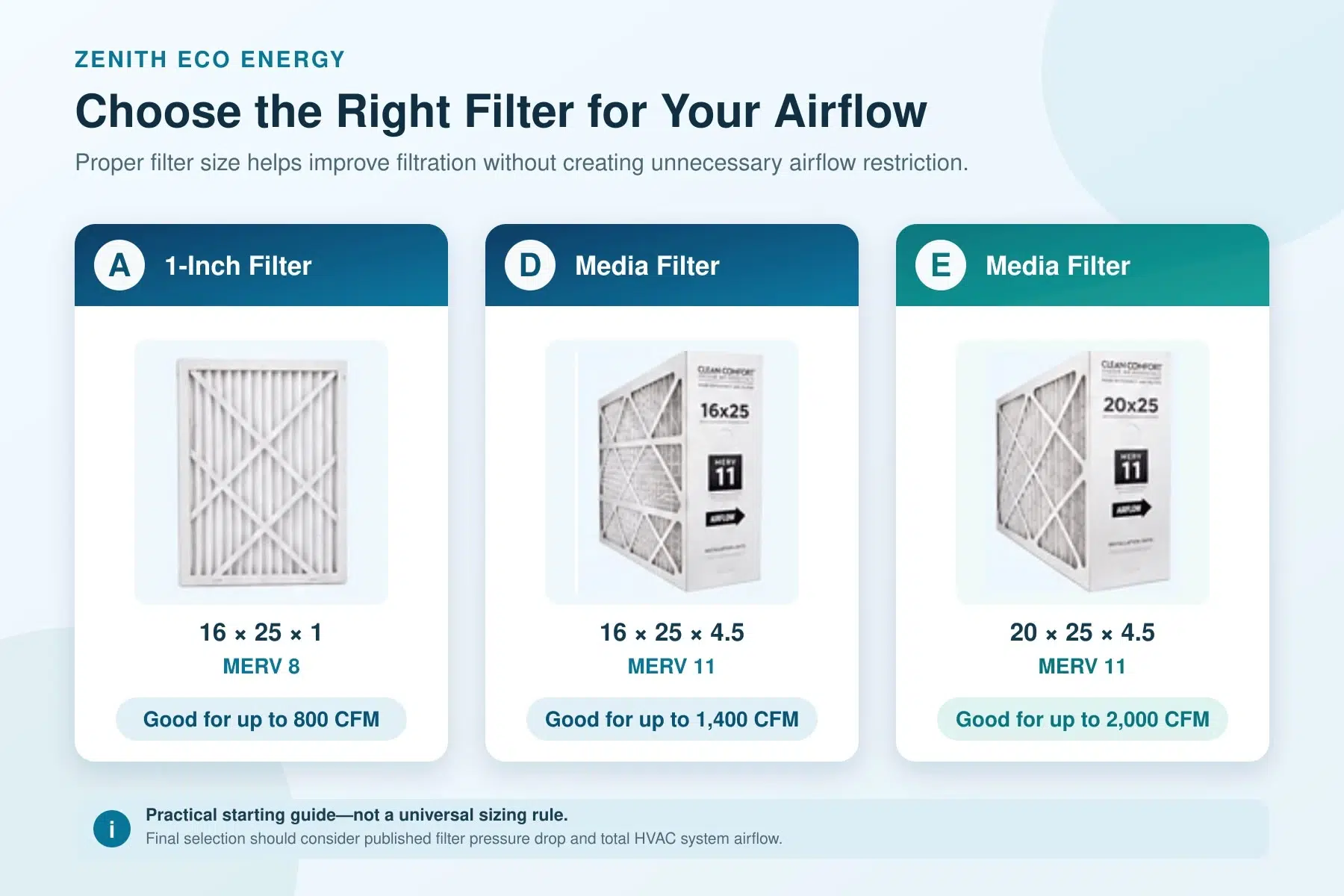
A properly sized media filter cabinet can provide:
- Better particle filtration
- Lower resistance than a dense one-inch filter with similar efficiency
- Greater dust-holding capacity
- Longer filter service life
- Better protection against air bypass when installed correctly
However, a media filter cabinet should not simply be installed wherever there is enough physical space.
The cabinet must be matched to the system’s required airflow and connected using a properly designed return transition or return boot.
If the cabinet opening, return transition or return duct is too small, installing a larger filter may not solve the airflow problem.
How Should a Media Filter Cabinet Be Sized?
The filter cabinet should be selected according to the airflow required by the HVAC equipment—not only according to the available space beside the furnace.
The following table provides Zenith Eco Energy’s practical starting guidelines for common residential HVAC systems:
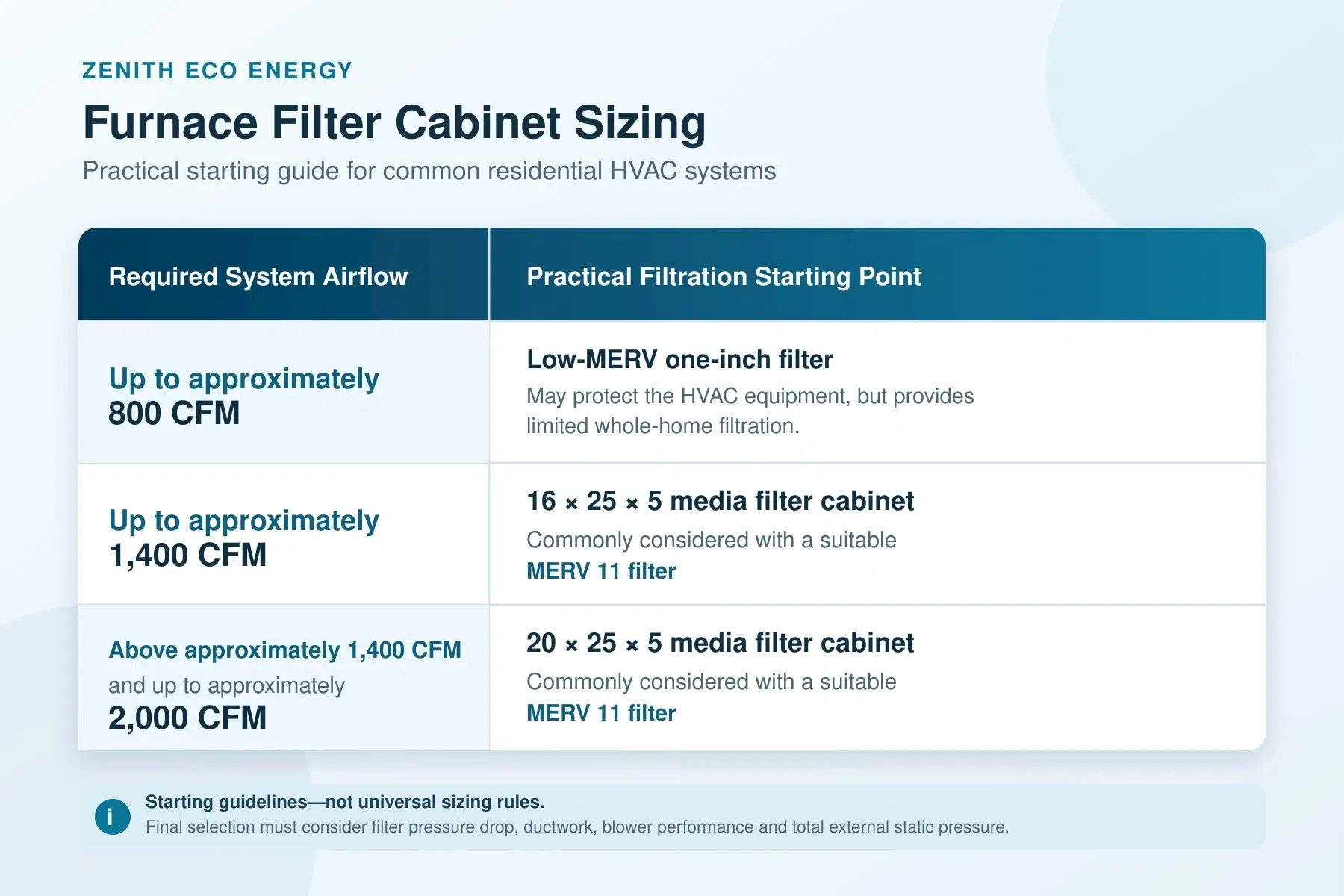
These numbers are practical starting points, not universal sizing rules.
The technician must also consider:
- The exact filter model
- The manufacturer’s published pressure drop
- The required HVAC airflow
- Furnace or air-handler specifications
- Blower settings and performance
- Evaporator-coil size and resistance
- Return-duct capacity
- Total external static pressure
For example, a 16 × 25 × 5 filter may be marketed for airflow approaching 1,400 CFM. However, using it below its advertised maximum can provide a safer pressure-drop margin.
Zenith Eco Energy commonly uses a 16 × 25 × 5 media filter cabinet for systems requiring up to approximately 1,200 CFM. When the airflow requirement is higher, we normally consider a 20 × 25 × 5 cabinet.
The objective is not to install the smallest cabinet that can technically pass the required air. The objective is to provide enough filter surface area for effective filtration without creating unnecessary airflow resistance.
Why Do the Return Boot and Return Duct Matter?
Installing a larger media filter cabinet will not correct an undersized return-air system by itself.
The furnace blower must pull air through several components:
- Return-air grilles
- Return ducts
- Return boot or transition
- Air filter
- Furnace or air handler
- Evaporator coil
A restriction at any of these points can reduce the total system airflow.
If a large media filter cabinet is connected through a small or poorly designed transition, the air may not enter the filter evenly. This can increase air velocity through part of the filter, create additional noise and reduce the benefit of installing the larger cabinet.
A proper installation may require a larger return boot, a smooth transition and turning vanes where the airflow changes direction.
The return ductwork must also be capable of delivering the required amount of air to the furnace blower.
The Filter Must Be Sealed Correctly
Air follows the easiest available path.
If there are gaps around the filter, some return air may travel around the filter instead of passing through it. This condition is called filter bypass.
The HVAC system may appear to have a good filter while unfiltered air continues carrying dust toward the blower, furnace and evaporator coil.
The filter should:
- Fit the cabinet correctly
- Face the correct airflow direction
- Sit firmly without large gaps
- Have a cabinet door that closes and seals properly
- Be accessible for regular inspection and replacement
An expensive filter cannot work properly if the air is allowed to bypass it.
Is a Higher-MERV Filter Ever a Good Choice?
Yes, provided that the HVAC system is designed or modified to support it.
A higher-efficiency filter may be helpful for households concerned about fine particles, pollen, pet-related particles or outdoor smoke. However, the decision should be based on more than the MERV rating printed on the filter.
Before increasing filter efficiency, the technician should evaluate:
- Required system airflow
- Filter dimensions and depth
- Clean-filter pressure drop
- Expected pressure increase as the filter becomes dirty
- Return-duct capacity
- Filter-cabinet capacity
- Total external static pressure
- Furnace and air-handler specifications
- Blower performance
The correct question is not:
“What is the highest-MERV filter I can buy?”
The correct question is:
“What level of filtration can this HVAC system support while maintaining proper airflow?”
How Can You Tell Whether the Filter Is Causing a Problem?
Possible warning signs include:
- The HVAC system becomes louder after installing a new filter
- Airflow from the supply registers becomes noticeably weaker
- The furnace begins cycling on the high-limit switch
- The air conditioner runs for long periods but provides less cooling
- Ice develops on the refrigerant line or evaporator coil
- The filter bends or is pulled toward the blower
- Dust appears around gaps in the filter cabinet
- Comfort problems become worse after changing to a higher-MERV filter
These signs should be investigated.
Removing the filter is not an acceptable solution. Operating an HVAC system without a filter can allow dust and debris to contaminate the blower, furnace and evaporator coil.
What Filtration Cannot Fix
HVAC filtration is primarily designed to capture particles carried through the return-air system.
Filtration cannot correct:
- Inadequate fresh-air ventilation
- High carbon dioxide caused by occupancy and insufficient ventilation
- Carbon monoxide
- Radon
- Excessive or insufficient indoor humidity
- A moisture or mould source
- Gases and odours that require source control or specialized treatment
- Dust that settles before reaching a return-air grille
Filtration is an important part of indoor air quality, but it is not the complete solution.
How Zenith Eco Energy Evaluates HVAC Filtration
Before recommending a stronger filter or larger media filter cabinet, Zenith Eco Energy can evaluate:
- Existing filter size, depth and MERV rating
- Filter condition and replacement history
- Signs of air bypass around the filter
- Required HVAC airflow
- Filter-cabinet capacity
- Return boot and return-duct sizing
- Airflow noise
- Blower settings
- Total external static pressure when required
- How the proposed filter may affect both the furnace and air conditioner
If a filter upgrade is appropriate, the cabinet and return transition should be selected according to the required airflow—not simply according to the available space.
Need Better Filtration Without Restricting Your HVAC System?
If your Ottawa home is dusty or you want better whole-home filtration, do not begin by installing the strongest one-inch filter you can find.
Start by confirming what your existing HVAC system can safely support.
Zenith Eco Energy can inspect your filter, filter cabinet, return-air system and HVAC airflow. We can then explain whether you need a different filter, a properly sized media filter cabinet or corrections elsewhere in the system.
Call Zenith Eco Energy at 613-800-9022.
Request a Filtration and Airflow AssessmentCall 613-800-9022
