
Water around your furnace during the cooling season usually comes from the air-conditioning system above it.
There are several possible causes, but these are the most common:
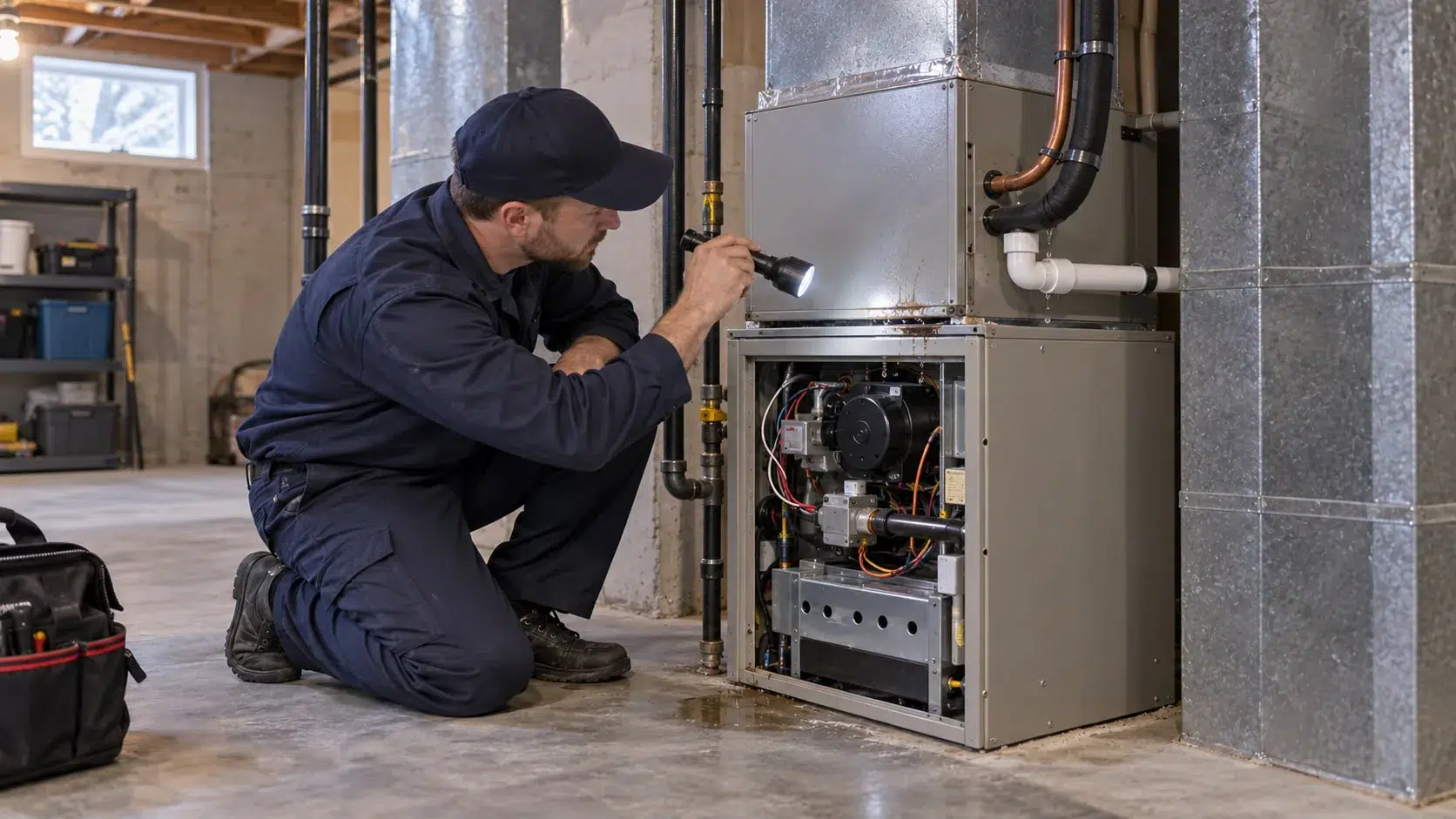
1. Clogged Condensate Drain
When your air conditioner runs, it removes moisture from the air. That water normally drains away through the condensate line.
If the drain becomes blocked by dirt, dust, algae, or debris, the water can back up and leak around or into the furnace.
2. Low Airflow
When there is not enough airflow across the evaporator coil, the coil can become too cold and start to freeze.
Once the system shuts off or the ice begins to melt, the extra water may overflow the drain pan and leak around or into the furnace.
Low airflow can be caused by a dirty or restrictive filter, blocked return air, a dirty blower wheel, a dirty evaporator coil, closed or blocked registers, or undersized ductwork.
This is why an AC water leak is not always just a drain problem. Sometimes the real cause is an airflow problem that needs to be corrected.
Proper airflow is important not only for cooling, but also for preventing coil freezing, reducing system stress, and keeping the HVAC system operating properly.
3. Cracked or Damaged Drain Pan
The evaporator coil sits above the furnace, and the water it produces normally collects in a drain pan before flowing into the condensate drain.
If the drain pan is cracked, rusted, damaged, or not properly positioned, water can leak directly around or into the furnace instead of reaching the drain line.
This type of leak may continue even if the condensate drain itself is clear.
4. Low Refrigerant
Low refrigerant can cause the evaporator coil to become too cold and start to freeze.
When that ice melts, the extra water may overflow the drain pan and leak around or into the furnace.
Refrigerant does not normally get “used up” by the air conditioner. If the refrigerant level is low, it usually means there is a leak somewhere in the system.
Simply adding refrigerant may temporarily improve cooling, but it does not repair the leak. The system should be properly diagnosed to find out why the refrigerant is low and whether the leak can be repaired.
Signs of low refrigerant can include weak cooling, longer run times, ice on the refrigerant line or evaporator coil, and water leaking after the ice melts.
What Should You Do If Your AC Is Leaking Water?
If you notice water around or inside the furnace while the air conditioner is running, the first step is to turn the AC off.
Continuing to run the system can make the leak worse and may cause additional damage.
You can then:
- Check the air filter and replace it if it is very dirty
- Look for ice on the refrigerant line or around the evaporator coil
- Check whether the condensate drain appears blocked or backed up
- Clean up any standing water around the furnace
- Avoid repeatedly restarting the AC if the coil is frozen or water continues to leak
- Call an HVAC technician if the cause is not obvious or the leak returns
Do Not Assume It Is Just a Clogged Drain
A blocked drain is common, but it is not the only reason an air conditioner can leak water.
Low airflow, a damaged drain pan, or low refrigerant can also cause the problem.
Simply clearing the drain may stop the water temporarily without fixing the real cause.
The most important step is to find out why the water is leaking before continuing to run the system.
Book AC Service with Zenith Eco Energy
If your air conditioner is leaking water, Zenith Eco Energy can inspect the system, identify the cause, and recommend the proper repair.
