
Prepared by Matt Zare | Zenith Eco Energy Inc., Ottawa, Ontario
This article combines Canadian indoor-air and ventilation guidance with practical observations from Zenith Eco Energy’s field experience in Ottawa-area homes.
Most homeowners think of their HVAC system as equipment that simply heats or cools the house.
But during an Ottawa summer, temperature is only part of the comfort equation.
Your cooling system also has to manage moisture.
A home can be 22°C or 23°C and still feel sticky, heavy or uncomfortable if indoor humidity remains high. That is why good HVAC performance is not just about reaching the thermostat setting.
A properly designed system should manage:
Temperature + Humidity + Airflow + Ventilation
together.
Your Air Conditioner Is Also a Dehumidifier
One of the most important things homeowners should understand is that an air conditioner does more than lower temperature.
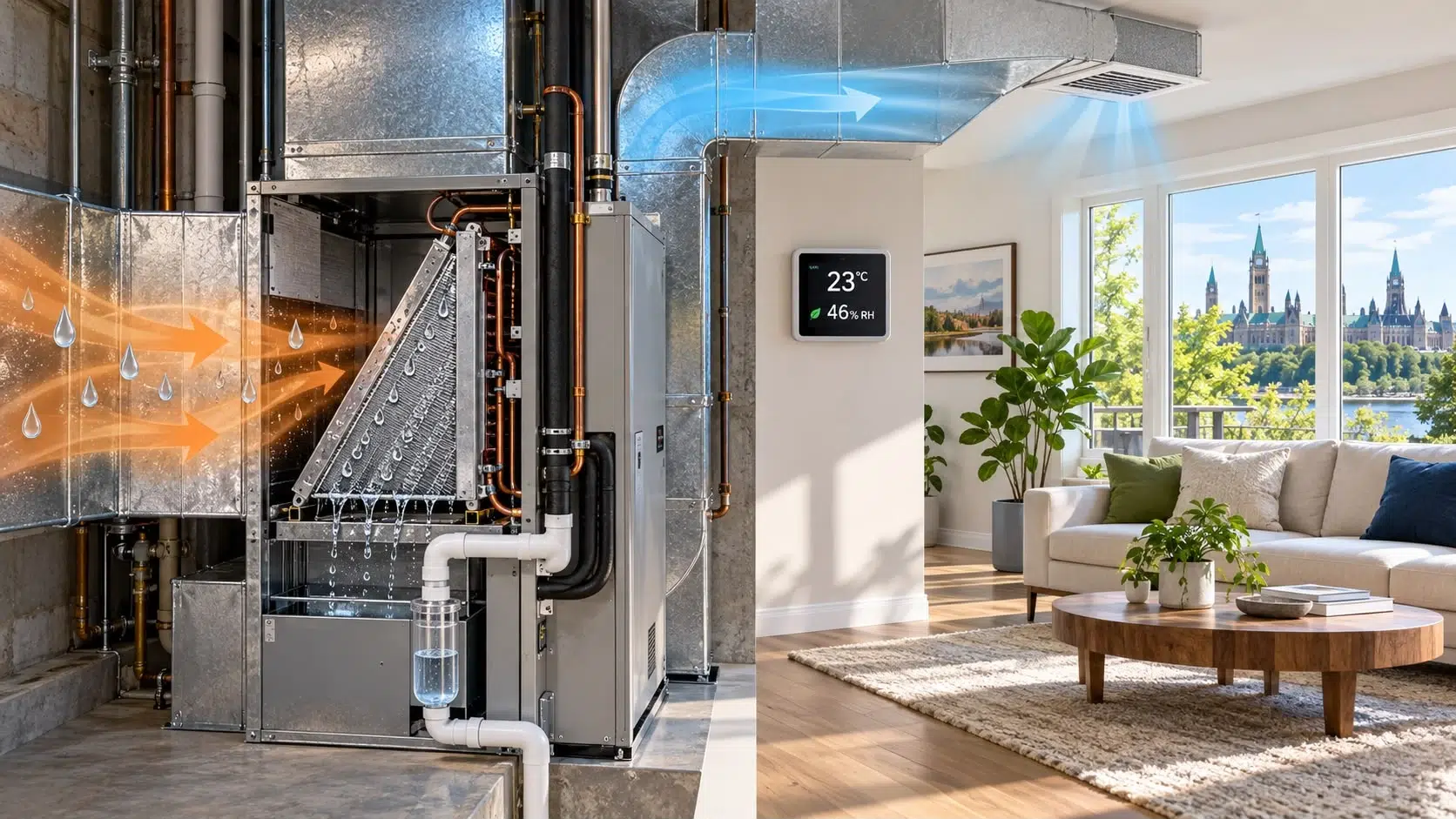
When warm, humid indoor air passes over the cold evaporator coil, the surface of the coil can fall below the air’s dew point.
Water vapour then condenses on the coil.
That water flows into the condensate pan and leaves the system through the condensate drain.
So your AC performs two different jobs:
Sensible Cooling
Lowering the air temperature.
Latent Cooling
Removing moisture from the air.
This is why an air conditioner is also an important part of your home’s dehumidification system.
On a dry day, more of the system’s capacity may be used to reduce temperature.
On a hot and humid day, a significant part of that capacity may also be needed to remove moisture.
Two summer days with the same outdoor temperature can create very different loads on an air conditioner if the humidity is different.
Why Does an AC Work Harder When Humidity Is High?
During humid weather, the AC has two jobs instead of one.
It must remove:
- Heat from the home
- Moisture from the air
Removing moisture requires cooling capacity.
That means a hot, humid day can place a greater load on the system than a similarly hot but much drier day.
This also explains why homeowners sometimes notice longer AC runtimes during humid weather even when the outdoor temperature has not changed dramatically.
Humidity is part of the cooling load.
Real Zenith Field Observation: How Much Water Can an AC Remove?
One of the easiest ways to understand dehumidification is to see the water coming out of the system.
During hot and humid summer conditions, we sometimes show homeowners how much condensate their air conditioner is actually removing from the indoor air.
In real service conditions, Zenith Eco Energy has observed approximately:
0.05 to 0.16 litres of condensate per minute
in some systems.
If that rate continued for one hour, it would equal approximately:
3 to 9.6 litres of water per hour.
This is not a fixed specification for every air conditioner.
The actual amount varies depending on:
- indoor humidity
- outdoor humidity
- indoor and outdoor temperature
- AC capacity
- airflow
- evaporator coil temperature
- runtime
- building conditions
But the observation demonstrates something very important:
Your AC may be removing a significant amount of water from your home during humid weather.
How Much Water Can Your AC Remove From the Air in One Minute?

What If the AC Is Running but Producing Very Little Condensate?
On a hot and humid day, a properly operating air conditioner will normally remove some moisture from the air.
If the home remains humid while the AC is running, but very little condensate appears to be leaving the system, it may be worth investigating.
Possible causes can include:
- evaporator coil not getting cold enough
- refrigerant issues
- dirty evaporator coil
- incorrect airflow
- blower speed that is too high
- short cycling
- oversized equipment
- condensate drainage problems
- thermostat or control issues
However, low condensate alone does not prove that the AC has a problem.
The indoor humidity, outdoor conditions and system runtime must also be considered.
The more important question is:
Is the house humid even though the cooling system is operating?
If the answer is yes, the system may not be dehumidifying properly.
Why an Oversized AC Can Leave Your Home Cool but Humid
Many homeowners assume that a larger air conditioner must perform better.
That is not always true.
An oversized AC can lower the indoor temperature very quickly.
The thermostat reaches its setpoint and shuts the cooling cycle off.
But good dehumidification requires runtime.
Humid indoor air needs enough time to pass over the cold evaporator coil so that moisture can condense and drain away.
If the system cools the home too quickly and repeatedly short cycles, temperature may be controlled before enough moisture is removed.
The result can be:
A cool home that still feels humid and uncomfortable.
This is one reason proper equipment sizing is so important.
Bigger Is Not Always Better
An AC should be selected based on the actual cooling load of the home, not simply by choosing the largest system available.
A properly sized system generally has a better opportunity to provide longer, more effective cooling cycles and humidity control.
Why Airflow Matters for Humidity Control
AC capacity is only one part of the equation.
Airflow across the evaporator coil also affects dehumidification.
If airflow is too high, air may move across the coil too quickly for optimal moisture removal.
If airflow is too low, the system can develop other problems, including reduced capacity or coil freezing.
That means blower speed and airflow should be properly matched to the equipment.
This is why a quality installation should include more than simply connecting the new AC.
Proper setup should consider:
- equipment sizing
- blower settings
- ductwork
- supply airflow
- return airflow
- system commissioning
Humidity control starts with the system operating as a complete system.
A Low Thermostat Setting Does Not Always Mean Better Comfort
Suppose your thermostat shows:
23°C
but the house still feels warm and sticky.
A common reaction is to lower the thermostat to 21°C.
That may make the AC run longer, but the real problem may be excessive humidity rather than temperature.
When humidity is properly controlled, the same home may feel much more comfortable at a higher thermostat setting.
That is why homeowners should look at both:
Temperature and Relative Humidity
instead of temperature alone.
Should You Turn Off Your AC at Night to Save Energy?
This is a common question.
Some homeowners turn the AC completely off at night because the outdoor temperature has dropped.
But an important point is often missed:
Leaving the AC switched on does not mean the compressor runs all night.
If the house has already reached the thermostat setpoint, the AC will cycle off automatically.
If both temperature and humidity are under control, the system may not need to run for a long period.
The bigger issue is what happens when outdoor air is cool but still very humid.
For example:
Outside: 20°C
The homeowner may think:
“It is cool outside. I should turn off the AC and open the windows.”
But if the outdoor dew point is high, that air may still carry a large amount of moisture.
Opening the windows can bring that moisture indoors.
The following morning, the AC may have to remove both:
- heat
- the moisture that entered overnight
So the decision should not be based on temperature alone.
Cool air is not always dry air.
If outdoor air is truly cool and dry, the AC will naturally run very little anyway.
Why Opening Windows on a Cool Summer Night Can Increase Humidity
Ottawa often has summer nights when temperature falls but humidity remains high.
That can be misleading.
The air feels cooler outside, but it may still contain a significant amount of moisture.
When windows are opened, that moisture enters the home.
Some of it may also be absorbed by indoor materials such as:
- carpets
- furniture
- wood
- drywall
- fabrics
Later, the AC must remove that moisture again.
That is why homeowners should pay attention to dew point and humidity, not only outdoor temperature.
How Does an HRV Affect Indoor Humidity?
An HRV is designed primarily for ventilation.
It removes stale indoor air and introduces fresh outdoor air while recovering part of the heat between the two air streams.
But its effect on humidity changes with the season.
This is particularly important in Ottawa, where summer and winter conditions are very different.
What Does an HRV Do to Humidity in Winter?
Ottawa winter air is cold and contains relatively little moisture.
An HRV exhausts indoor air and replaces it with outdoor air.
Heat is recovered through the heat exchanger, but a standard HRV does not transfer moisture in the same way an ERV does.
So relatively dry outdoor air enters the house.
Once that air is warmed, its relative humidity becomes even lower.
As a result, an HRV can reduce indoor humidity during winter.
This may help a house with excessive condensation.
However, if the house is already dry, excessive ventilation can contribute to over-drying.
This is why HRV operation should match the actual needs of the home.
Can a Humidifier and HRV Work Against Each Other?
In some situations, yes.
Imagine this:
The whole-home humidifier is adding moisture.
At the same time, the HRV is exhausting humid indoor air and replacing it with dry outdoor air.
Both pieces of equipment may be operating exactly as designed, but the controls may not be optimized for the conditions.
This does not mean the HRV or humidifier is unnecessary.
It means humidity and ventilation should be managed together.
What Does an HRV Do to Humidity in Summer?
Summer creates the opposite challenge.
Outdoor air may be warm and very humid.
An HRV can reduce some of the heat transfer associated with ventilation, but a standard HRV does not significantly recover moisture.
That means outdoor moisture can still enter the home with the ventilation air.
The AC must then remove that additional moisture.
So during humid summer weather:
More humid outdoor ventilation air = more dehumidification load on the cooling system
This does not mean the HRV should simply be shut off.
Ventilation is important for indoor air quality.
The goal is to make sure the ventilation system is:
- properly sized
- properly balanced
- correctly controlled
- appropriate for the house
HRV vs. ERV: Which Is Better for Humidity?
Both HRVs and ERVs exchange stale indoor air with fresh outdoor air.
The key difference is moisture transfer.
HRV
Primarily transfers heat.
ERV
Transfers heat and some moisture.
This can be useful in both summer and winter.
In Summer
An ERV can transfer some moisture from the incoming humid outdoor air toward the outgoing exhaust stream.
This can reduce the amount of outdoor moisture entering the home.
In Winter
An ERV can retain some of the indoor moisture that would otherwise be exhausted.
This may reduce excessive winter dryness.
However:
An ERV is not automatically better for every home.
The right choice depends on:
- building airtightness
- occupancy
- indoor moisture generation
- climate
- existing HVAC equipment
- ventilation requirements
The best system is the one that fits the actual house.
Should You Turn Off an HRV in Summer?
Not simply because outdoor humidity is high.
Fresh-air ventilation is important for indoor air quality.
If the HRV appears to be contributing to high summer humidity, the better approach is to evaluate:
- ventilation rate
- operating schedule
- controls
- system balancing
- AC dehumidification performance
- whether an ERV may be more appropriate
Turning ventilation completely off may reduce one source of moisture while creating other indoor-air-quality problems.
Can High Humidity Cause Condensation on Ductwork?
Yes.
This is an issue we see in humid conditions.
Supply-air ducts can become very cold while the AC is operating.
If the surface temperature of the duct falls below the dew point of the surrounding air, water can condense on the duct surface.
This can happen on:
- exposed metal ducts
- poorly insulated ducts
- ductwork in basements
- attic ductwork
- ducts in crawlspaces
- mechanical rooms
Persistent condensation can contribute to:
- rust
- corrosion
- wet insulation
- water staining
- damaged duct insulation
- musty odours
If dust and debris repeatedly become wet inside or around the duct system, they can become damp, sticky or muddy.
Persistent moisture can also create conditions that support microbial growth and unpleasant odours.
Important
Duct cleaning alone may not solve the problem.
If the real cause is:
- high humidity
- poor duct insulation
- air leakage
- low duct surface temperature
the underlying cause must be corrected.
Why Duct Insulation Matters
Cold supply air passing through a warm, humid space creates a strong potential for condensation.
Proper insulation helps keep the outer surface of the duct from becoming too cold.
It also reduces unwanted heat gain into the supply air.
If insulation is:
- missing
- damaged
- wet
- poorly sealed
condensation risk can increase.
This is particularly important in basements, attics and other humid or unconditioned spaces.
Can Basement Humidity Be Related to HVAC Airflow?
Yes.
Basements are usually cooler than upper floors, so their relative humidity can naturally be higher.
But airflow distribution can also matter.
If the basement receives supply air but has poor return-air circulation, air may not mix effectively with the rest of the house.
That can contribute to stagnant, cool and humid conditions.
However, a return-air problem should not automatically be blamed for all basement humidity.
Other possible causes include:
- foundation moisture
- poor drainage
- groundwater
- plumbing leaks
- basement temperature
- air leakage
- inadequate dehumidification
A proper diagnosis should consider all of these factors.
Is Continuous Fan Operation Always Good for Humidity?
Not always.
After the compressor turns off, the evaporator coil may still be wet.
If the blower continues running for an extended period, some moisture left on the coil can evaporate back into the indoor air.
The effect varies by system and control setup.
So continuous fan operation should not automatically be considered the best choice for every home during humid weather.
Fan strategy should match the equipment and humidity-control goal.
Signs Your AC May Not Be Controlling Humidity Properly
Your system may need to be checked if you notice:
- the house is cool but still feels muggy
- indoor RH stays consistently high
- the AC frequently short cycles
- the AC runs for long periods but humidity remains high
- very little condensate appears during hot, humid conditions
- condensation develops on ductwork
- the basement remains humid
- the temperature looks good but comfort is poor
- musty odours continue
- humidity varies significantly between floors
None of these signs alone proves a specific mechanical problem.
But they can provide useful clues.
What Should Be Checked When Humidity Is Not Under Control?
Before installing another piece of equipment, the cause should be identified.
Important items may include:
- AC sizing
- evaporator coil condition
- refrigerant charge
- blower speed
- airflow
- system runtime
- thermostat setup
- condensate drainage
- duct insulation
- duct leakage
- supply and return distribution
- basement airflow
- HRV or ERV operation
- ventilation balance
- building air leakage
- other moisture sources
Sometimes the answer is a dehumidifier.
Sometimes airflow needs adjustment.
Sometimes the AC is oversized.
Sometimes the ventilation system needs to be balanced.
And sometimes the moisture source is not HVAC-related at all.
Why Humidity Control Matters for Energy Efficiency
Humidity can affect energy use in several ways.
If a home feels muggy, the homeowner may lower the thermostat simply to feel more comfortable.
That can increase AC runtime.
At the same time, the cooling system is already using capacity to remove moisture from the air.
Better humidity control can therefore improve comfort without relying only on lower thermostat settings.
This does not mean that every humidity improvement produces a fixed percentage of energy savings.
Actual energy use depends on the building, equipment, weather and homeowner settings.
But good humidity control can help avoid unnecessary overcooling.
Temperature Control and Humidity Control Should Work Together
This may be the most important idea in this article.
A good HVAC system should not only make the house colder.
It should help create a comfortable indoor environment.
During summer:
Cooling + Dehumidification
both matter.
A 22°C house with high humidity may feel less comfortable than a slightly warmer house with properly controlled humidity.
The goal is not simply the lowest temperature.
The goal is comfortable temperature with controlled moisture.
When Should Your HVAC System Be Checked?
A professional evaluation may be useful if:
- the AC cools the house but humidity remains high
- the system short cycles
- condensate production appears unusual
- ductwork repeatedly sweats
- basement humidity stays high
- airflow is poor between floors
- the HRV or ERV does not appear to be operating properly
- energy use seems unusually high
- the house feels uncomfortable despite a reasonable thermostat setting
A good diagnosis should focus on finding the cause, not simply selling another piece of equipment.
Final Takeaway
Your HVAC system does much more than control temperature.
A comfortable and efficient home depends on:
- Temperature
- Humidity
- Airflow
- Ventilation
working together.
In summer, the air conditioner removes both heat and moisture.
If the AC is oversized, airflow is incorrect or runtime is too short, the home may become cool without being properly dehumidified.
HRVs and ERVs also affect moisture differently depending on the season.
In winter, an HRV can contribute to lower indoor humidity.
In summer, humid outdoor ventilation air can increase the moisture load on the AC.
High humidity can also affect the HVAC system itself by contributing to duct condensation, wet insulation, corrosion and musty odours.
That is why:
Proper humidity control is part of good HVAC design, not an optional extra.
And for homeowners, perhaps the most important point is this:
A comfortable home is not simply a cold home. It is a home where temperature and moisture are controlled together.
Frequently Asked Questions
Is an air conditioner also a dehumidifier?
Yes. During cooling, moisture condenses on the evaporator coil and leaves the home through the condensate drain.
Why does my AC work harder when humidity is high?
Because the system must remove both heat and moisture from the indoor air.
Does a bigger AC remove humidity better?
Not necessarily. An oversized AC may cool the house too quickly and shut off before enough moisture is removed.
Why is my house cool but still humid?
The temperature may be under control while humidity remains high. Oversized equipment, short cycling, airflow problems or ventilation can all contribute.
Should I turn the AC off at night?
If outdoor conditions are cool and dry, the AC will naturally run very little. If outdoor air is cool but humid, turning the system off and opening windows can increase indoor moisture.
Can an HRV make my house dry in winter?
Yes. An HRV can introduce cold, dry outdoor air and may contribute to over-drying in some homes.
Can an HRV increase humidity in summer?
Yes. Humid outdoor ventilation air can increase the indoor moisture load and increase the amount of dehumidification required from the AC.
Is an ERV always better than an HRV?
No. ERVs transfer some moisture and may be beneficial in certain homes, but the correct choice depends on the building and ventilation requirements.
Why does my ductwork sweat in summer?
Condensation forms when the duct surface becomes colder than the dew point of the surrounding air.
Can poor basement return airflow contribute to humidity?
Yes. Poor circulation can contribute to higher basement humidity, although foundation moisture, drainage and water leaks should also be investigated.
About This Article
Prepared by Matt Zare, Zenith Eco Energy Inc.
Zenith Eco Energy has served homeowners in the Ottawa area since 2013.
Some practical observations and examples in this article, including condensate measurement, humidity behaviour, airflow issues and duct condensation, are based on Zenith Eco Energy’s field experience with residential HVAC systems in Ottawa-area homes.
General guidance on indoor humidity, ventilation, HRVs and ERVs is supported by Canadian public-health and energy-efficiency resources.
References
- Health Canada, Ventilation and the Indoor Environment
Information on mechanical ventilation, HRVs, ERVs, winter dryness and summer humidity. - Natural Resources Canada, Heat and Energy Recovery Ventilators
Guidance on ventilation, energy recovery, moisture transfer and HRV/ERV operation. - Natural Resources Canada, What’s a Heat/Energy Recovery Ventilator and Why Do I Need One?
Explanation of HRV and ERV differences, including moisture transfer. - Health Canada, Ventilation and Indoor Air Quality
General guidance on ventilation and indoor-air-quality management.
