
Prepared by Matt Zare | Zenith Eco Energy Inc., Ottawa, Ontario
This article combines Canadian indoor-air and building-science guidance with practical observations from Zenith Eco Energy’s field experience in Ottawa-area homes.
Indoor humidity affects much more than how comfortable your home feels.
Too much moisture can contribute to window condensation, damp basements, musty odours, mould growth and moisture damage. Too little humidity can make the air uncomfortable during Ottawa’s cold winters and contribute to dry skin, static electricity and other dry-air problems.
Humidity can also affect your indoor air quality, energy use and the building envelope itself.
For most homes, Health Canada recommends maintaining indoor relative humidity between approximately 30% and 50%. However, there is no single humidity setting that is right for every home or every day of the year.
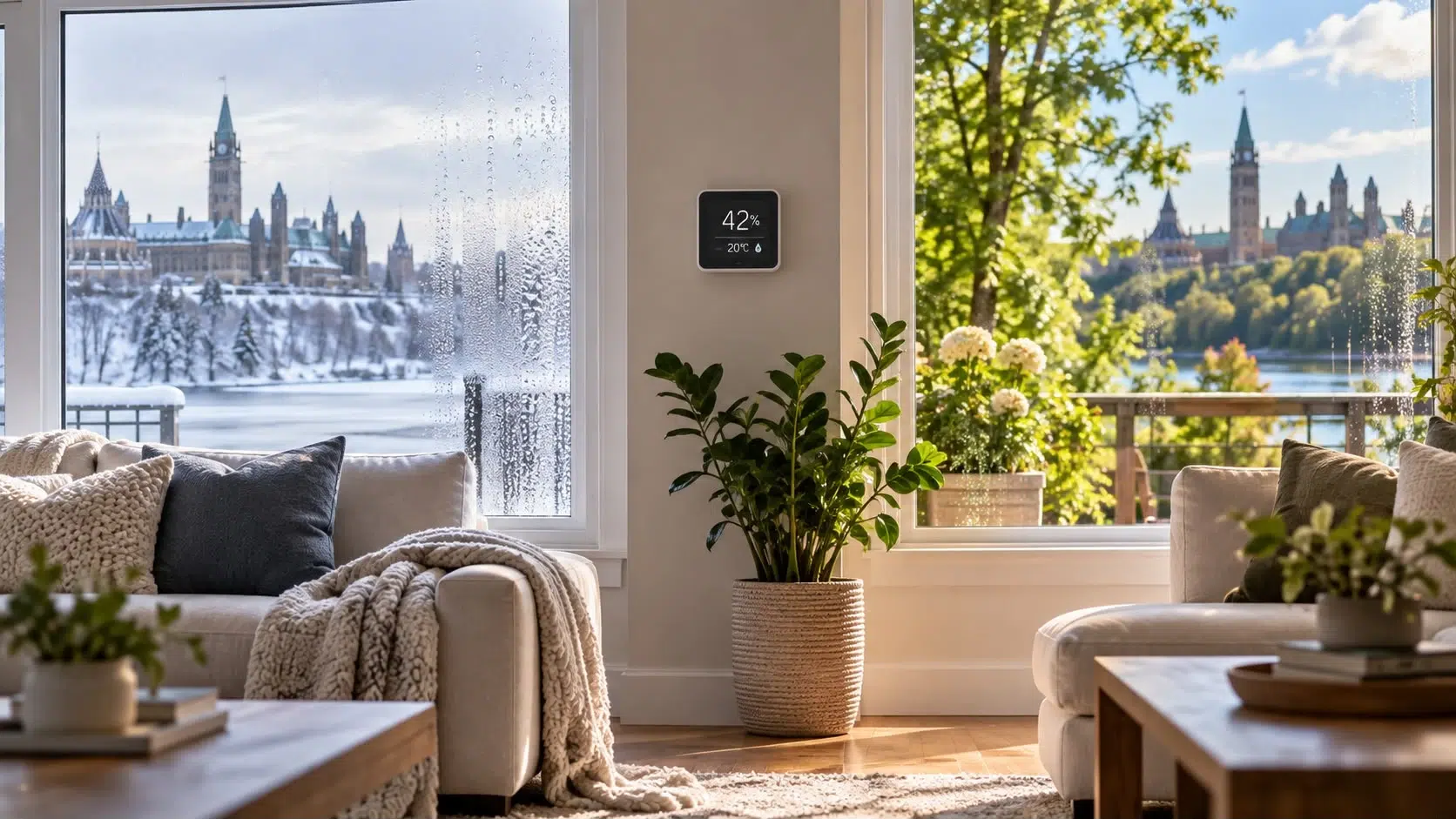
In Ottawa, the appropriate humidity level can change significantly between a humid July afternoon and a -25°C winter night.
The goal is not maximum humidity or minimum humidity.
The goal is the right humidity for the conditions inside and outside your home.
What Is Humidity?
Humidity is the amount of water vapour present in the air.
The number normally shown on a thermostat, humidistat or hygrometer is called Relative Humidity, or RH.
Relative humidity describes how much moisture is in the air compared with how much moisture that air could hold at its current temperature.
Temperature is important because warm air can contain much more water vapour than cold air.
This explains why the same home can experience very different humidity problems in summer and winter.
It also helps explain:
- condensation on windows
- sweating cold-water pipes
- damp basements
- dry winter air
- condensation on other cold surfaces
What Is Dew Point?
Dew point sounds technical, but the basic idea is simple.
When moist air touches a surface that is cold enough, the air next to that surface eventually reaches a temperature where it can no longer hold all of its water vapour.
Some of that water vapour becomes liquid water.
That is condensation.
A simple example is a cold drink sitting outside on a humid summer day. Water appears on the outside of the glass even though the glass is not leaking.
The same principle applies inside your home.
Condensation can occur on:
- windows
- cold-water pipes
- cold ductwork
- basement surfaces
- poorly insulated areas
- other cold building surfaces
This is why humidity problems depend on more than just the percentage shown on a thermostat.
The temperature of the surface matters too.
Why Does Indoor Humidity Increase in Summer?
Ottawa summers can be both hot and humid.
When humid outdoor air enters the house, it brings its moisture with it.
Outdoor air can enter through:
- open windows and doors
- air leakage around the building envelope
- cracks and gaps
- ventilation systems
- normal movement in and out of the house
This means that when you bring outdoor air into your home, you are not only bringing in its temperature.
You are also bringing in its moisture.
Cool Air Is Not Always Dry Air
This is something homeowners often overlook.
The outdoor temperature may drop significantly in the evening while the outdoor air remains very humid.
A homeowner may see that it is only 20°C outside and assume that opening the windows will improve indoor conditions.
But if the outdoor dew point is high, that cooler air may still contain a large amount of moisture.
Opening the windows can then increase indoor humidity.
This is why, during an Ottawa summer:
Outdoor temperature is not the only number that matters. Humidity and dew point matter too.
Why Does a Home Become Dry in Winter?
Winter creates almost the opposite problem.
Cold outdoor air contains much less actual moisture than warm summer air.
That cold air enters the house through:
- normal ventilation
- opening doors
- air leakage
- gaps in the building envelope
Once the outdoor air enters the house and is heated to normal room temperature, its relative humidity drops significantly.
This is one of the major reasons homes can become extremely dry during long periods of cold Ottawa weather.
A house with significant uncontrolled air leakage may experience this effect more strongly because cold, dry outdoor air is continuously entering the building.
Does the Furnace Actually Dry the Air?
Homeowners often say:
“My furnace dries out my house.”
The observation is understandable, but technically the furnace itself is usually not removing moisture from the air.
What is happening is that cold outdoor air enters the house and then gets heated.
As that air becomes warmer without additional moisture being added, its relative humidity becomes much lower.
So the dry feeling associated with heating season is often related to:
- cold outdoor conditions
- air leakage
- ventilation
- indoor moisture production
- how tightly the house is constructed
rather than the furnace literally removing water from the air.
What Should Indoor Humidity Be in Winter?
There is no single winter humidity setting that works under all conditions.
A general indoor range of 30% to 50% RH is commonly recommended, but the building itself may require lower humidity during very cold weather.
For example, 40% RH may cause no problems on a mild winter day.
But during a -25°C night, that same 40% RH may cause condensation on colder windows or other building surfaces.
That is why setting a humidistat once in October and leaving it unchanged until April is not always a good approach.
Your house gives you feedback.
If significant window condensation begins appearing as outdoor temperatures fall, the indoor humidity may be too high for the conditions.
Why Do Windows Sweat in Winter?
Window condensation happens when warm, moist indoor air contacts a cold window surface.
The air next to the glass cools.
If the glass is cold enough to reach the dew point, water vapour condenses on the surface.
Three important factors determine whether this happens:
Indoor Humidity + Outdoor Temperature + Window Surface Temperature
As outdoor temperatures fall, the inside surface of the window generally becomes colder.
The colder the surface becomes, the easier it is for condensation to form.
Window Efficiency Can Make a Big Difference
Humidity is not the only reason one window may sweat more than another.
A low-efficiency window allows more heat transfer from inside the house to outdoors.
As a result, the inside glass surface can become colder.
A colder surface is more likely to reach the dew point and develop condensation.
High-performance windows can reduce this risk through features such as:
- double or triple glazing
- low-e coatings
- insulated frames
- improved spacers
- greater airtightness
- insulating gas such as argon between the panes
Better insulation keeps the interior surface of the window warmer.
What Happens if a Double- or Triple-Pane Window Loses Its Seal?
Many modern insulated windows have a sealed space between the panes. That space may contain an inert insulating gas such as argon.
If the sealed glass unit fails, its performance can decrease.
Moisture may also enter between the panes.
If you see fogging or condensation between the glass panes, the sealed glass unit may have failed.
Depending on the window design and the condition of the frame, it may be possible to replace only the insulated glass unit rather than the entire window.
What If Only One Window Has Condensation?
This can be an important clue.
If almost every window in the house is clear but one particular window repeatedly develops condensation, the humidity level of the entire house may not be the main problem.
That individual window could have:
- poorer thermal performance
- a damaged seal
- excessive air leakage
- an installation problem
- a failed insulated glass unit
- a colder surface than the other windows
So before reducing the humidity throughout the entire house, the individual window should be examined.
If every window is fine except one, consider the window itself, not just the humidity of the house.
Can Sweating Cold-Water Pipes Be a Sign of High Humidity?
Yes.
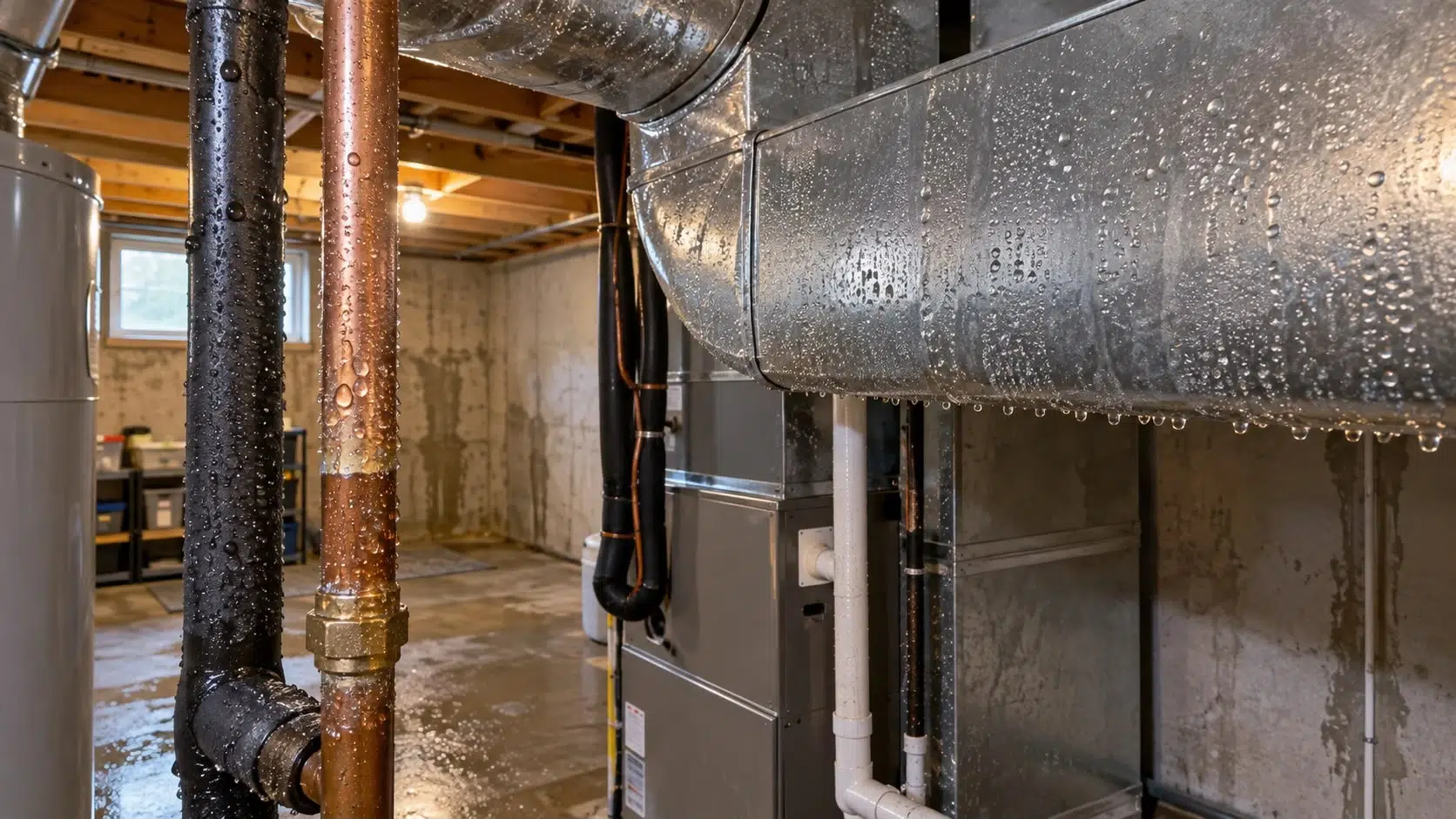
During humid summer weather, cold water moving through a pipe can make the pipe surface much colder than the surrounding air.
If the pipe surface drops below the dew point, moisture from the surrounding air condenses on it.
The pipe appears to “sweat.”
A small amount of temporary condensation may occur under certain conditions.
But if cold-water pipes are regularly covered with condensation during the summer, particularly in a basement or utility area, it can be a useful warning sign that humidity in that area is high.
Pipe insulation may reduce condensation, but the underlying humidity level should also be considered.
Why Are Basements Often More Humid Than the Rest of the House?
Basements frequently have higher relative humidity than upper floors.
There are several reasons.
Basements are cooler
Because relative humidity depends on temperature, cooler basement air can have a higher RH than warmer upstairs air.
Moisture may enter through the building
Possible sources include:
- foundation moisture
- cracks
- water infiltration
- groundwater
- plumbing leaks
- poor exterior drainage
Air circulation may be weaker
A basement may also have less effective air circulation than the main floor.
If conditioned air is supplied to a basement but there is inadequate return-air circulation, air may not mix effectively with the rest of the house.
This can contribute to stagnant, cool and humid conditions.
However, lack of return airflow should not automatically be assumed to be the cause. Foundation moisture, drainage and water leakage should also be investigated.
Where Does Indoor Moisture Come From?
Not all indoor moisture comes from outdoors.
Normal household activities can add significant amounts of water vapour to the air.
Common sources include:
- showers
- cooking
- breathing
- drying clothes indoors
- plants
- aquariums
- plumbing leaks
- wet basements
This is why controlling moisture at the source is often more effective than trying to correct the problem afterward.
Use bathroom exhaust fans during showers and allow them to continue running afterward.
Use the kitchen exhaust when cooking, particularly when producing steam.
Make sure clothes dryers vent properly outdoors.
And repair water leaks promptly.
Before adding another piece of equipment, it is worth asking:
Where is the moisture coming from?
What Happens When Indoor Humidity Is Too High?
High humidity is not only a comfort issue.
Persistent excess moisture can contribute to:
- window condensation
- damp materials
- musty odours
- sweating pipes
- basement moisture
- moisture damage
- conditions that support mould growth
- deterioration of some building materials
Repeated moisture is especially important.
One brief period of condensation does not necessarily indicate a serious problem.
But surfaces that remain wet or repeatedly become wet should be investigated.
What Happens When Indoor Humidity Is Too Low?
Very dry air can also reduce comfort.
Common signs can include:
- dry skin
- dry nose or throat
- static electricity
- dry-feeling indoor air
- changes in some wood flooring or furniture
A whole-home humidifier can be helpful in the right situation.
But more humidity is not always better.
If a humidifier is set too high during very cold weather, it can contribute to condensation on windows and other cold surfaces.
A malfunctioning humidifier or incorrect control setting can also introduce more moisture than the building can tolerate.
The goal is controlled humidification, not maximum humidification.
Humidity Control Helps Protect the Building Envelope
Humidity management is not only about the air.
Moisture interacts with the entire house.
If moist indoor air repeatedly reaches cold areas of the building envelope, condensation can occur.
Over time, persistent moisture can affect materials such as:
- insulation
- drywall
- wood
- window components
- framing
- other building materials
Air leakage is especially important because moisture can travel with moving air through small openings in the building envelope.
This is why humidity, insulation and air sealing should not be treated as completely separate issues.
The house should be considered as one system.
What If Only One Corner or Wall Has Condensation?
Location can tell us a lot.
If many windows and cold surfaces throughout the house have condensation, general indoor humidity may be too high.
But if condensation repeatedly occurs only in one corner, one small section of wall or one specific area, there may be a localized building-envelope problem.
Possible causes include:
- missing or insufficient insulation
- thermal bridging
- air leakage
- unusually low surface temperature
Simply lowering humidity throughout the entire home may reduce the symptom without correcting the underlying problem.
How Does Humidity Affect Comfort?
Humidity has a major effect on how temperature feels.
During summer, the human body uses evaporation of perspiration as part of its cooling process.
When humidity is high, that evaporation becomes less effective.
As a result, a home can feel warm, sticky or uncomfortable even when the thermostat shows a reasonable temperature.
Two homes at the same indoor temperature can therefore feel very different if their humidity levels are different.
During winter, extremely dry air can also reduce comfort.
This is one reason temperature alone does not tell the whole story.
Why Humidity Control Matters for Indoor Air Quality, Energy and Your Home
Proper humidity management affects three major areas:
1. Indoor Air Quality
Persistent excessive moisture can contribute to dampness, musty odours and conditions that support mould growth.
Extremely dry air can also reduce comfort.
2. Energy Efficiency
Humidity affects how comfortable a given temperature feels.
In summer, homeowners may lower the thermostat because the house feels muggy even when the temperature itself is reasonable.
Humidity also creates additional work for cooling and dehumidification equipment.
We will cover this relationship in detail in our separate guide on how HVAC systems control indoor humidity.
3. Building Envelope Protection
Condensation can affect windows, insulation, walls and other building materials.
Proper humidity control helps reduce unnecessary moisture exposure and protect the home itself.
How Can Ottawa Homeowners Control Indoor Humidity?
Start by measuring, not guessing.
Use a hygrometer or a thermostat with a humidity sensor.
If a reading seems unusual, comparing it with another humidity meter can be useful because sensors are not always perfectly accurate.
Then consider the house as a complete system.
In Summer
- Monitor indoor humidity.
- Keep windows closed when outdoor conditions are very humid.
- Use kitchen and bathroom exhaust fans correctly.
- Repair plumbing and building leaks.
- Investigate basement moisture.
- Check foundation drainage.
- Use a dehumidifier when appropriate.
- Investigate repeated condensation on pipes or other cold surfaces.
In Winter
- Monitor humidity as outdoor temperature changes.
- Adjust humidifier settings rather than leaving one setting all winter.
- Reduce humidification if significant window condensation appears.
- Check excessive air leakage.
- Use bathroom and kitchen ventilation appropriately.
- Investigate isolated cold surfaces or individual problem windows.
Should Indoor Humidity Stay the Same All Year?
No.
This is one of the most important points for Ottawa homeowners.
Ottawa has humid summers and very cold winters.
The correct humidity strategy therefore changes through the year.
Summer
The main objective is usually to prevent excess moisture from accumulating indoors.
Fall
Monitor humidity as outdoor temperature begins to fall and prepare the humidifier and ventilation system for winter.
Winter
Add moisture if necessary for comfort, but not to the point where condensation develops.
As outdoor temperatures become colder, the home may require a lower RH.
Very Cold Winter Weather
If significant condensation or frost appears on windows or other cold surfaces, indoor humidity may be too high for the current outdoor conditions or there may be a local envelope/window issue.
Spring
As outdoor temperatures and moisture levels rise, winter humidification usually needs to be reduced or shut down.
Humidity control should change with the season.
Is Every Humidity Problem an HVAC Problem?
No.
This is an important distinction.
HVAC equipment can affect indoor humidity, but it cannot correct every source of moisture.
A humidity or condensation problem may be related to:
- foundation moisture
- plumbing leaks
- poor drainage
- failed windows
- insulation problems
- air leakage
- ventilation
- building-envelope problems
- HVAC operation
Sometimes several factors are involved at the same time.
The correct solution starts with finding the actual cause.
Final Takeaway
Indoor humidity should not be treated as one number that is set once and forgotten.
For most homes, 30% to 50% relative humidity is a useful general range, but the correct level depends on the season, outdoor temperature, building envelope and the home itself.
Watch what your house is telling you.
Persistent window condensation, sweating cold-water pipes, damp basement areas, musty odours, unusually dry air or one repeatedly wet window can all provide useful clues.
Proper humidity control supports:
- Comfort
- Indoor Air Quality
- Energy Efficiency
- Building Envelope Protection
The best humidity level is not simply the highest or lowest possible number.
It is the level that keeps the people comfortable while keeping the home dry and protected.
Frequently Asked Questions
What should indoor humidity be in an Ottawa home?
Health Canada generally recommends maintaining indoor relative humidity between approximately 30% and 50%. During very cold weather, some homes may require lower humidity to avoid condensation.
Is 40% humidity good in winter?
It can be, but not in every home or at every outdoor temperature. During very cold Ottawa weather, 40% RH may cause condensation on some windows or other cold surfaces.
Why does my house get dry when the furnace runs?
The furnace usually does not directly remove moisture. Cold, dry outdoor air enters the home and then has a much lower relative humidity after being heated.
Why do my windows sweat in winter?
Moist indoor air is contacting a window surface that is cold enough to fall below the dew point.
Why does only one window have condensation?
If other windows are dry, that particular window may have lower thermal performance, air leakage, a failed seal or another localized problem.
Does condensation between window panes mean the window is bad?
It can indicate failure of the sealed insulated glass unit. The glass unit may need replacement, although the entire window does not always need to be replaced.
Are sweating cold-water pipes a sign of high humidity?
They can be. Condensation occurs when the pipe surface is colder than the dew point of the surrounding air. High indoor humidity makes this more likely.
Why is my basement more humid than upstairs?
Basements are usually cooler and can also be affected by foundation moisture, drainage, water leaks and poor air circulation.
Should I keep my humidifier at the same setting all winter?
Usually not. Humidity should be adjusted as outdoor temperatures change and should be reduced if significant condensation appears.
Is every humidity problem caused by the HVAC system?
No. Building-envelope problems, windows, insulation, air leakage, plumbing, drainage, foundations and ventilation can all contribute.
About This Article
Prepared by Matt Zare, Zenith Eco Energy Inc.
Zenith Eco Energy has served homeowners in the Ottawa area since 2013.
Some practical observations and diagnostic examples discussed in this article are based on Zenith Eco Energy’s field experience with residential HVAC systems, humidity, airflow and condensation issues in Ottawa-area homes.
General indoor humidity, moisture, mould, condensation and building-envelope guidance is based on Canadian public-health and building-science resources listed below.
References
- Health Canada, Healthy Home Guide: Health Canada recommends maintaining indoor humidity between approximately 30% and 50% and addressing excessive moisture to reduce mould risk.
- Health Canada, Mould and Indoor Moisture: Guidance on moisture sources, basement dampness, exhaust ventilation, hygrometers, dehumidification and preventing mould growth.
- Natural Resources Canada, Condensation: Explains window condensation, broken insulated-glass seals, air circulation and energy-efficient window features including triple glazing, low-e coatings and inert gas between panes.
- Natural Resources Canada, Keeping the Heat In: How Your House Works: Building-science guidance on dew point, condensation, relative humidity, air leakage, moisture movement and protection of the building envelope.
- Natural Resources Canada, Humidity Levels and Moisture Control: Practical guidance on humidifiers, ventilation, basement moisture, drainage, exhaust fans and reducing excess humidity.
